Computer Technology is so built into our lives that it’s part of the surround of every artist. — Steven Levy
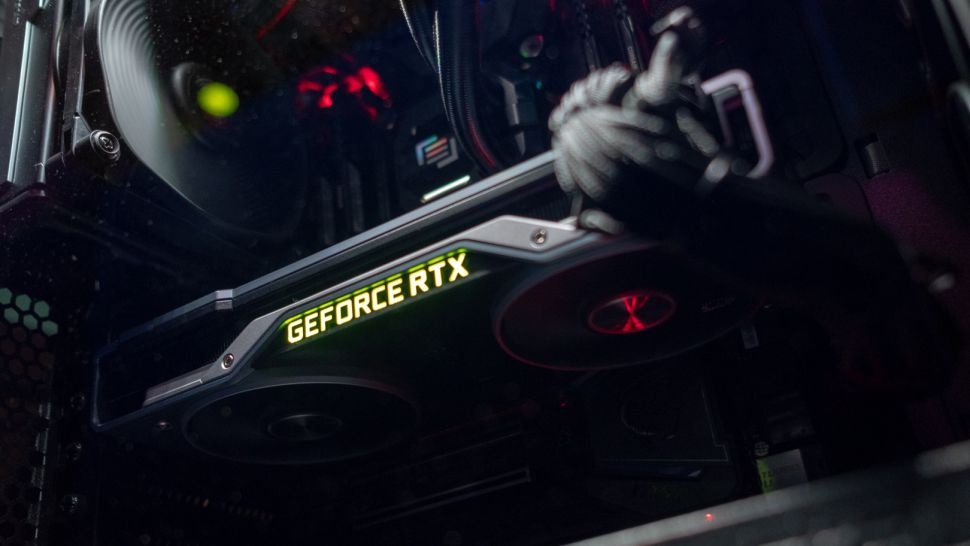
Nvidia announced last August 20 at Gamescom the release of the long-awaited new generation graphics card, the GeForce RTX 20 series, a family of graphics processing unit developed by the company. The GPU are Turing Powered
Nvidia Turing architecture
The Turing GPUs have been designed with a focus on compute-based rendering, as such they combine traditional rasterized rendering hardware with AI and ray tracing-focused silicon. The individual SMs of Turing have also been redesigned to offer a 50% performance improvement over the Pascal SM design.
It is said that, The Turing-powered Nvidia GeForce RTX 2080 Ti, RTX 2080 are poised to be the best graphics cards for the games we play over the next few years.
NVIDIA RTX 2080 SPECS
The Founders Edition cards of the new Nvidia Turing generation all sport factory overclocked GPUs with shiny twin axial coolers. That means there is a slight difference in the specs sheet between the reference RTX 2080 and the first cards Nvidia has sent out itself. They still operate the same basic TU104 GPU and that means they’re both rocking some fine-ass silicon inside them.
Despite nominally using a smaller production process with the Turing chips, when compared with the Pascal GPUs – 12nm vs. 16nm – the RTX 2080 is bigger than the GP102 of the GTX 1080 Ti. Now, an extra 74mm2 might not sound like a lot, but that’s a fair jump in scale gen-on-gen. And compared with the 314mm2 GP104 inside the GTX 1080 you’re talking about a difference of 231mm2.
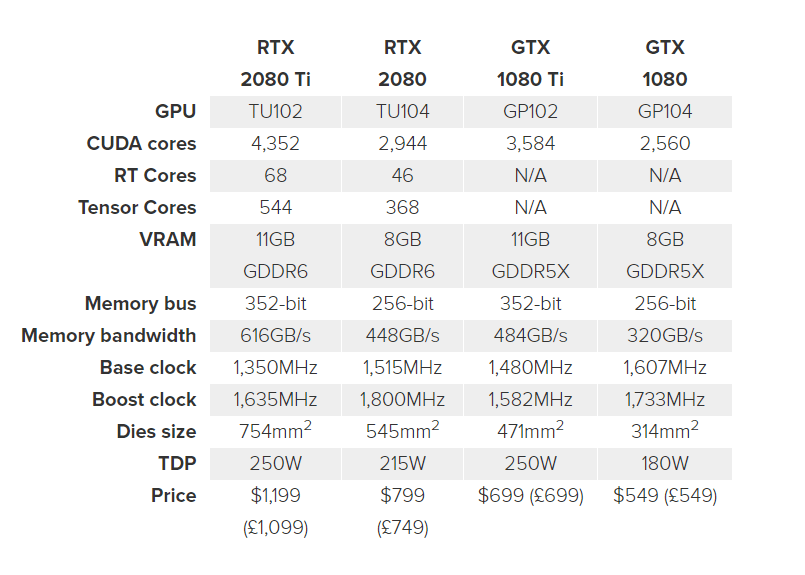 The RTX 2080 Ti starts with $1,199 (₱64,855) while the RTX 2080 is at $799 (₱43,272)

 thetechguide